MHTCET PCB is one of the most competitive state-level entrance exams for students aspiring to secure admission in medical, pharmacy, and allied health science courses in Maharashtra.
If you are a 12th Science (PCB) student targeting MBBS, BDS, BAMS, B.Pharm, or nursing programmes in Maharashtra, clearing MHTCET PCB is your most direct route to a government or private college seat. Every year, over 4 lakh students appear for the PCB paper, making it crucial that you enter this exam not just prepared but strategically prepared.
The difference between a good score and a great score often comes down to understanding the exact syllabus, the exam structure, and where to invest your study time. This guide covers everything you need: complete MHTCET PCB syllabus, exam pattern, subject-wise preparation tips, a 5-month study plan, and common mistakes to avoid. Whether you are starting fresh or doing final revision, this is your go-to resource.
Table of Contents
What is MHTCET PCB?
MHT CET stands for Maharashtra Health and Technical Common Entrance Test. The PCB paper refers to the Physics, Chemistry, and Biology stream, designed specifically for students who studied Biology in 11th and 12th standard and wish to pursue healthcare or life sciences programmes in Maharashtra.
The exam is conducted by the State Common Entrance Test Cell, Maharashtra. It tests students on the State Board curriculum with approximately 20% weightage from Class 11 topics and 80% from Class 12 topics. Scores from MHTCET PCB are used for admissions through the Centralised Admission Process (CAP).
Who Should Appear for MHTCET PCB?
-
- Students appearing in or having completed Class 12 with Physics, Chemistry, and Biology as main subjects
-
- Students targeting MBBS, BDS, BAMS, BHMS, B.Pharm, or B.Sc. Nursing admissions in Maharashtra
-
- Students preparing simultaneously for NEET (both exams share major syllabus overlap)
Important: A strong MHTCET PCB percentile, combined with a NEET score, significantly expands your college options across both government and private institutions in Maharashtra.
MHTCET PCB 2026 Exam Pattern
Before diving into preparation, every student must clearly understand the MHTCET PCB exam pattern. Here is the complete structure:
| Subject | Questions | Marks | Duration |
|---|---|---|---|
| Physics | 50 | 100 | 90 minutes |
| Chemistry | 50 | 100 | 90 minutes |
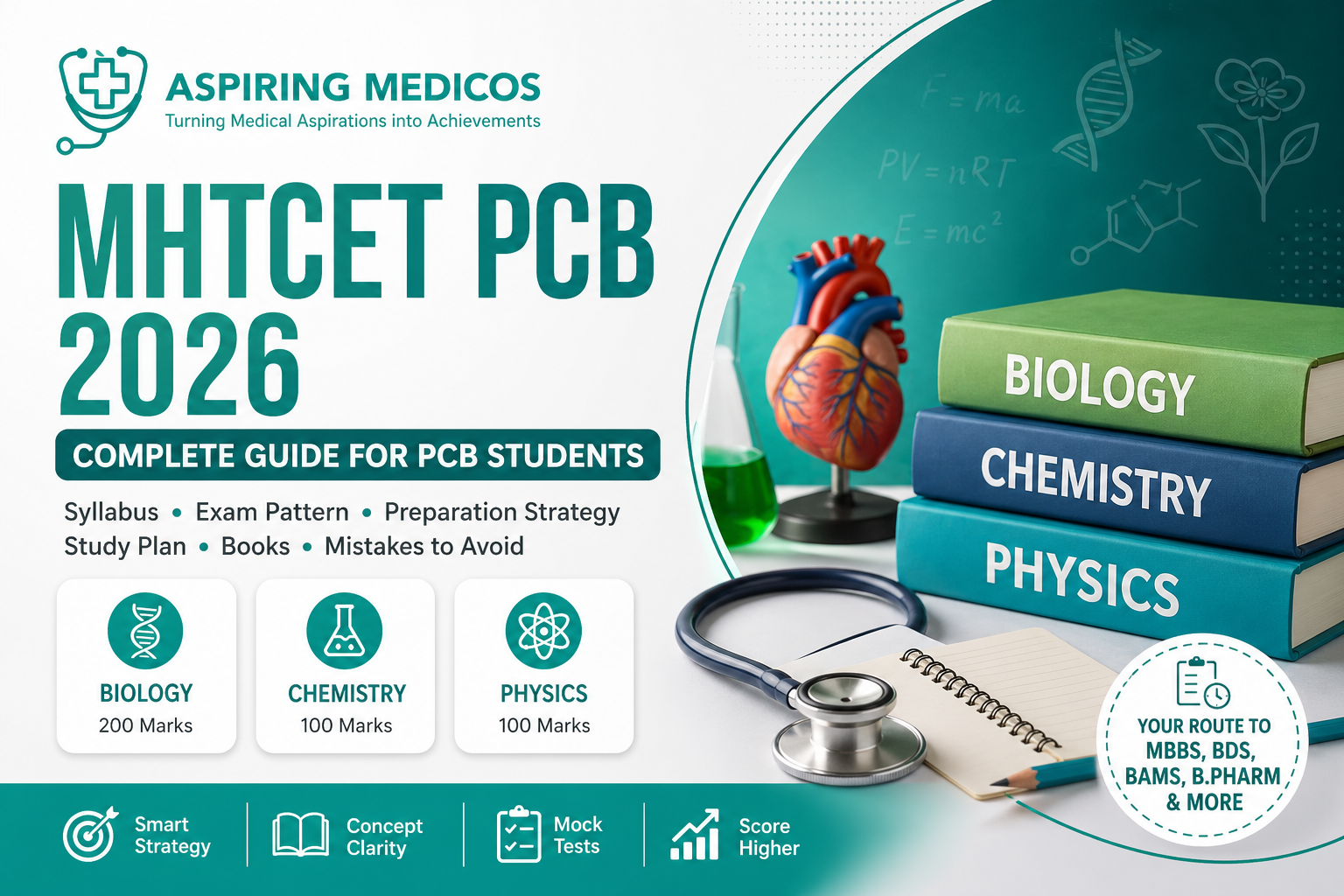
| Biology (Botany + Zoology) | 100 | 200 | 90 minutes |
| Total | 200 | 400 | 270 minutes |
Key Exam Pattern Highlights
-
- No negative marking: Every correct answer earns 2 marks. Wrong answers carry no penalty, so always attempt all questions.
-
- Questions are MCQ-based (4 options each).
-
- The exam is conducted online (Computer-Based Test).
-
- Biology carries the highest weightage at 200 marks, making it the single most important section.
-
- Physics and Chemistry are attempted in separate 90-minute slots.
Aspiring Medicos offers dedicated CET batch coaching for PCB students in Thane.Explore Our CET Preparation Course
MHTCET PCB Syllabus 2026
The MHTCET PCB syllabus is based on the Maharashtra State Board curriculum for Classes 11 and 12. Below is a subject-by-subject breakdown of the key topics you need to cover.
Biology: Botany + Zoology (200 Marks)
Biology is the most scoring and highest-weightage subject in MHTCET PCB. Students from Maharashtra State Board or CBSE will find this section highly manageable with thorough NCERT reading.
| Botany Topics | Zoology Topics |
|---|---|
| Reproduction in Plants | Human Reproduction |
| Genetics and Evolution | Genetics and Molecular Basis |
| Photosynthesis and Respiration | Human Health and Disease |
| Plant Physiology | Biotechnology and Applications |
| Ecology and Environment | Biodiversity and Conservation |
Physics (100 Marks)
Physics in MHTCET PCB is largely conceptual with moderate numerical questions. Key topics include:
-
- Circular Motion and Gravitation
-
- Electrostatics, Current Electricity, and Magnetic Effects
-
- Wave Optics and Interference
-
- Semiconductors and Communication Systems
-
- Thermodynamics and Kinetic Theory of Gases
Chemistry (100 Marks)
Chemistry is split across Physical, Organic, and Inorganic branches. Organic Chemistry is the most time-consuming section but also among the most scoring with the right approach.
-
- Solid State and Solutions (Physical)
-
- Electrochemistry and Chemical Kinetics (Physical)
-
- Aldehydes, Ketones, and Amines (Organic)
-
- Biomolecules and Polymers (Organic)
-
- p-Block and d-Block Elements (Inorganic)
Subject-wise Preparation Strategy for MHTCET PCB
Biology: Build Concept Clarity First
Since Biology carries 200 marks, your performance here directly shapes your percentile. A focused Biology strategy looks like this:
-
- Start with NCERT Class 11 and 12 Biology and read every line, not just headings.
-
- Make short notes on life processes, diagrams (cell division, reproduction), and classification.
-
- Pay special attention to Genetics, Ecology, and Biotechnology since these chapters are heavily tested every year.
-
- Revise diagram-based questions regularly. MHTCET frequently includes image-based MCQs.
-
- Practise previous year papers specifically for Biology to spot recurring question patterns.
Chemistry: Master Reactions and Formulae
-
- For Organic Chemistry, maintain a dedicated reaction sheet listing reactants, reagents, and products.
-
- Physical Chemistry requires formula retention. Solve at least 10 numericals per topic.
-
- For Inorganic Chemistry, focus on periodic trends and properties of elements in Groups 15, 16, and 17.
-
- Use mnemonics for complex reaction mechanisms so you can recall them quickly under exam pressure.
Physics: Focus on Application-Based MCQs
-
- MHTCET Physics is mostly conceptual. Understand the reasoning behind every formula, not just how to use it.
-
- Numericals from Electrostatics, Current Electricity, and Optics appear frequently.
-
- Solve a minimum of 20 MCQs per chapter after reading to test how well you have retained concepts.
-
- Avoid memorising derivations without understanding them. Apply them to MCQ scenarios instead.
Pro Tip: Students who score 150+ in Biology can compensate for moderate performance in Physics or Chemistry. If study time is limited, prioritise Biology to maximise your MHTCET PCB percentile.
5-Month Study Plan for MHTCET PCB
A structured study plan prevents last-minute panic and ensures every topic gets adequate attention. Here is a proven month-by-month plan:
| Month | Focus Areas | Activity |
|---|---|---|
| Month 1 and 2 | Biology (Botany + Zoology) | NCERT reading + chapter-wise tests |
| Month 3 | Chemistry (Organic + Inorganic) | Reaction practice + formula sheets |
| Month 4 | Physics + Numericals | Formula revision + MCQ sets |
| Month 5 | Full Revision + Mock Tests | 3 mocks per week + error analysis |
| Final 2 Weeks | Weak Areas + Previous Papers | Targeted revision + speed drills |
Daily Schedule Template
-
- 6:00 AM to 8:00 AM: Biology reading + short notes (fresh morning slot)
-
- 9:00 AM to 11:00 AM: Chemistry (reactions, concepts, numericals)
-
- 4:00 PM to 6:00 PM: Physics (theory + MCQ practice)
-
- 8:00 PM to 9:00 PM: Revision and flashcard review
-
- Weekends: Full chapter test + error analysis session
Want expert guidance and a structured test series for MHTCET PCB?Book a Free Counselling Session
MHTCET PCB vs NEET: Key Differences
Many students preparing for NEET wonder whether they need separate preparation for MHTCET PCB. Here is what you need to know:
-
- Syllabus Overlap: Both exams share approximately 80% of the Biology syllabus (NCERT-based). NEET additionally covers NCERT chapters not in the Maharashtra State Board syllabus.
-
- Difficulty Level: NEET is generally harder than MHTCET PCB in terms of question depth and complexity.
-
- Marking Scheme: NEET has a penalty of 1 mark per wrong answer. MHTCET PCB has zero negative marking.
-
- Language: MHTCET is available in English and Marathi. NEET is available in multiple regional languages.
-
- Scope: MHTCET PCB score is valid for Maharashtra admissions only. NEET score is valid nationally.
For a detailed breakdown of both preparation strategies, read our guide: NEET Coaching vs Self Study: What Should You Choose?
Best Books for MHTCET PCB Preparation
Biology
-
- NCERT Class 11 and 12 Biology (primary resource, non-negotiable)
-
- Maharashtra State Board Biology Textbooks (11th and 12th)
-
- MTG Objective Biology or Arihant Biology for MCQ practice
Chemistry
-
- NCERT Class 11 and 12 Chemistry
-
- Maharashtra State Board Chemistry Textbooks
-
- OP Tandon for Organic Chemistry (selective chapters)
Physics
-
- NCERT Class 11 and 12 Physics
-
- Maharashtra State Board Physics Textbooks
-
- DC Pandey MCQ Physics or Arihant Physics for MHT CET
External Resource: Download the official MHT CET 2026 information brochure from the State CET Cell Maharashtra at mahacet.org for the latest exam dates and admit card schedule.
Common Mistakes to Avoid in MHTCET PCB
Even well-prepared students lose marks due to avoidable errors. Watch out for these:
-
- Skipping State Board textbooks: Many students rely only on NCERT. MHT CET specifically includes Maharashtra State Board content, especially in Chemistry and Physics.
-
- Ignoring Class 11 syllabus: 20% of questions come from Class 11. Chapters like Breathing and Exchange of Gases, Human Excretory System, and Laws of Motion carry direct questions.
-
- Not attempting all questions: Since there is no negative marking, leaving questions blank is a direct loss of marks. Always guess from the remaining options if unsure.
-
- Weak time management in Biology paper: With 100 questions in 90 minutes, you have under 55 seconds per question. Weekly timed mock tests are non-negotiable.
-
- Using too many reference books: Stick to 2 resources per subject. Too many books create confusion and lead to incomplete revision.
More Resources from Aspiring Medicos
Ready to start your MHTCET PCB journey with expert guidance?Download Our CET Preparation Brochure
Frequently Asked Questions (FAQs) on MHTCET PCB
Q1. What subjects are included in MHTCET PCB?
MHTCET PCB includes Physics, Chemistry, and Biology (Botany and Zoology). Biology carries 200 marks while Physics and Chemistry carry 100 marks each, totalling 400 marks across three papers.
Q2. Is NCERT enough for MHTCET PCB preparation?
NCERT is the foundation for MHTCET PCB, especially for Biology. For Physics and Chemistry, you also need Maharashtra State Board textbooks (11th and 12th) since MHT CET follows the state board syllabus closely.
Q3. Is there negative marking in MHTCET PCB?
No. MHTCET PCB has no negative marking. Each correct answer earns 2 marks, and there is no penalty for incorrect answers. Students should attempt every single question.
Q4. Which subject is most important in MHTCET PCB?
Biology carries the highest weightage with 200 marks (100 questions), making it the most important subject. Strong Biology scores directly improve your overall percentile and admission chances.
Q5. Can I prepare for MHTCET PCB and NEET together?
Yes. Both exams share approximately 80% of their syllabus. A student preparing for NEET can simultaneously prepare for MHT CET PCB with focused revision on Maharashtra State Board-specific topics. Many students at Aspiring Medicos successfully crack both exams in the same cycle.